
What Halifax County Property Value Numbers Mean
Three numbers often travel under the same label. A Halifax County property value might sit in the land book as an assessment, appear in a deed as stated consideration, or circulate as a market estimate. They are related. They are not interchangeable. Halifax County assesses real estate at 100 percent of fair market value for taxation and reassesses every two years. That standard describes method, not outcome, so an assessed amount neither promises a sale price nor replaces a licensed appraisal of the parcel.
| Value type | Meaning | Where it appears |
|---|---|---|
| Assessed value | Halifax County value used in the land book for local taxation | Real Estate Assessment Office |
| Market value | An estimate of what a property might sell for under defined conditions | Requires an appraisal or other market analysis |
| Sale consideration | Amount stated in a recorded transfer instrument | Deed at Circuit Court Clerk |
| Tax amount due | Bill calculated using assessment and applicable rates | Treasurer's account |
Halifax County publishes current land-book information by September 1 each cycle. The assessment office's online pages do not list a public set of parcel-card fields. Ask the Commissioner which value labels apply and which tax year a given property's figure represents.
Finding a Halifax County Assessment Value
Start with the parcel in Halifax County WebGIS. You can also work from an address and parcel record number. The Commissioner of the Revenue handles land-book value questions. So does the Real Estate Assessment Office. The county posts no separate public assessor property-card page. Ask the office for the assessed value and the year it represents. Ask whether land and improvements are broken out separately. Never infer a field from a third-party page or a map label. For the standard and schedule behind these numbers, Halifax County's reassessment page explains the full-value approach. It also covers the timing.
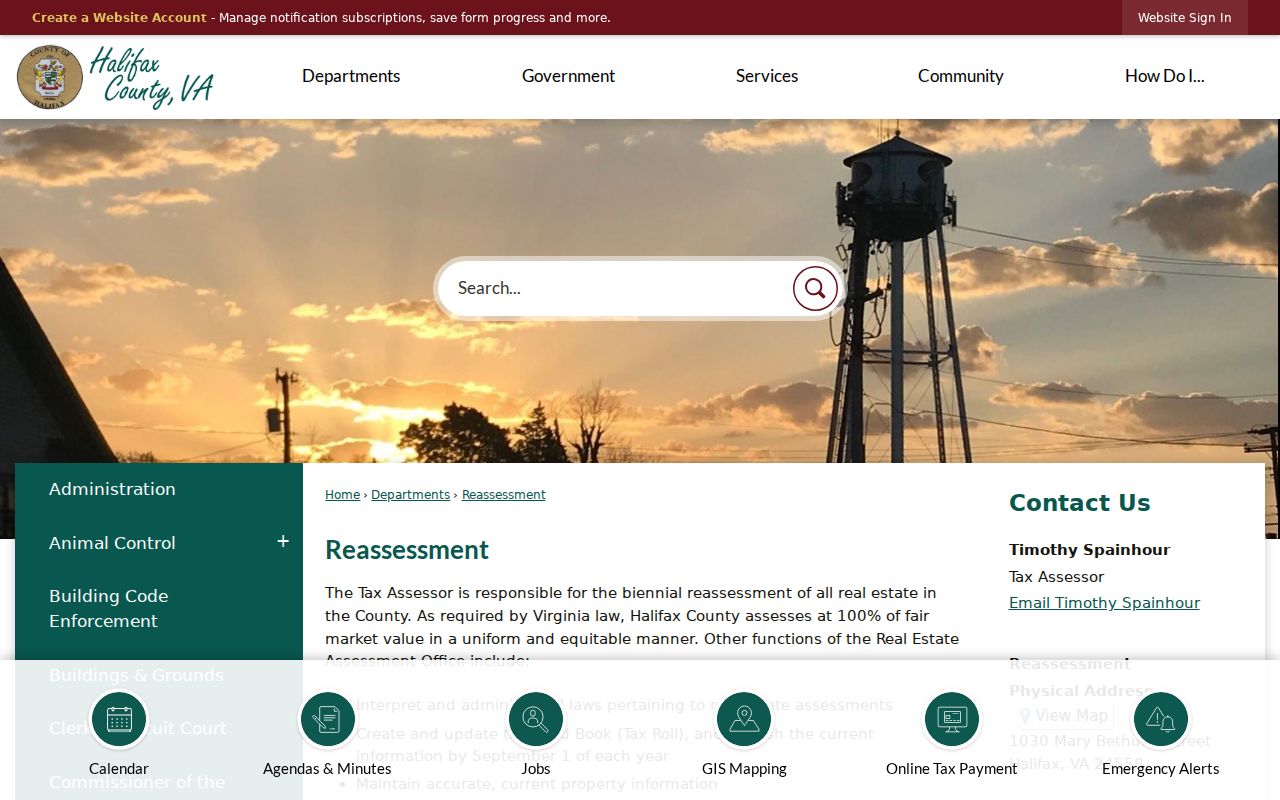
The county's reassessment materials state policy rather than parcel-specific values. For an actual sale figure, search the deed instrument through the Circuit Court Clerk. A deed's consideration may appear in the instrument itself. An index line alone may not show every term. Record the deed date and book/page citation separately from the assessment year. This keeps the two from blurring together.
Halifax County's Biennial Assessment Sets a Tax Baseline
The assessment office reassesses real estate every two years at 100 percent of fair market value. It applies the standard uniformly across the county. It also interprets assessment laws, builds and updates the land book, and keeps property information current. It answers procedural questions. It defends values before the Board of Equalization. Current land-book information appears by September 1. Those duties explain which record year a given value belongs to.
A reassessment resets the tax baseline. It does not document a sale. The assessment cycle can run ahead of or behind deed recording, map updates, and permit records. A value may look stale beside a recent transfer. When it does, check the assessment year. Ask whether the new deed has been reflected yet. If the land type or parcel description seems wrong, treat that as a record-description issue. Do not assume the value alone is the problem.
Date every figure you write down. A current assessment is not automatically a current market estimate.
Halifax County Property Value versus the $40,000 Deed
One Halifax County deed recorded in 2025 shows how the numbers can diverge. The instrument names parcel 30044 and states $40,000 in consideration. It also cites an assessed value of $19,240 and points to Book 701, Page 849 as the prior deed. The land itself is a two-acre tract laid out by metes and bounds. The gap between the two figures is not a mistake. Consideration and assessed value serve different purposes, and each may reflect a different date or method. Neither figure alone tells you what the parcel would fetch on the open market today.
A few habits make any deed-versus-value comparison safer. Check whether the deed amount is total consideration. Confirm that the parcel number and legal description match the records you are comparing against. Note which tax year the assessment reflects. And resist the urge to divide price or value by acreage in search of a universal price per acre for Halifax County. Land characteristics and transaction context matter far too much for that shortcut to hold.
| Figure | Source | Question it answers |
|---|---|---|
| $40,000 | Recorded sample deed | What consideration was stated in that transfer? |
| $19,240 | Assessment reference in the deed | What assessed amount was cited? |
| Two acres | Legal description | What tract size the instrument describes |
Halifax County Property Value Fields for Land and Improvements
Many assessor systems display land value, building improvements, and a combined total. Halifax County does not publish its exact owner-card field labels. So a public card's layout is not established. Call the assessment office before calling a displayed number land-only, improvement-only, or a total. Ask which tax year, parcel record number, and land type apply. The appeal form recognizes residential, commercial, and vacant-land categories. But that form does not reveal the public screen layout.
The land book is the county's authoritative assessment record. A deed can cite a prior assessment reference. Meanwhile, the Treasurer's account computes the tax bill under applicable rules and rates. Keep each number tied to its source. Merging them without noting which office produced which figure invites error.
Halifax County Property Value and Town Tax Context
Halifax County set its 2026 real-estate tax rate at $0.50 per $100 of assessed value. Installments come due June 5 and December 5. Property inside the Town of Halifax can carry town taxes as well. Those layers change the bill, not the assessed value itself. The Treasurer's page is the place to check current rates, payment instructions and any extension.
The county payment gateway also handles personal property and machinery-and-tools accounts. Their 2026 rates differ from the land rate. A payment total is an account calculation, never a second valuation figure. Before comparing bills, confirm the account type and the jurisdiction involved.
The Halifax County Treasurer page covers rates and due dates, while the property tax guide walks through bill and appeal routes.
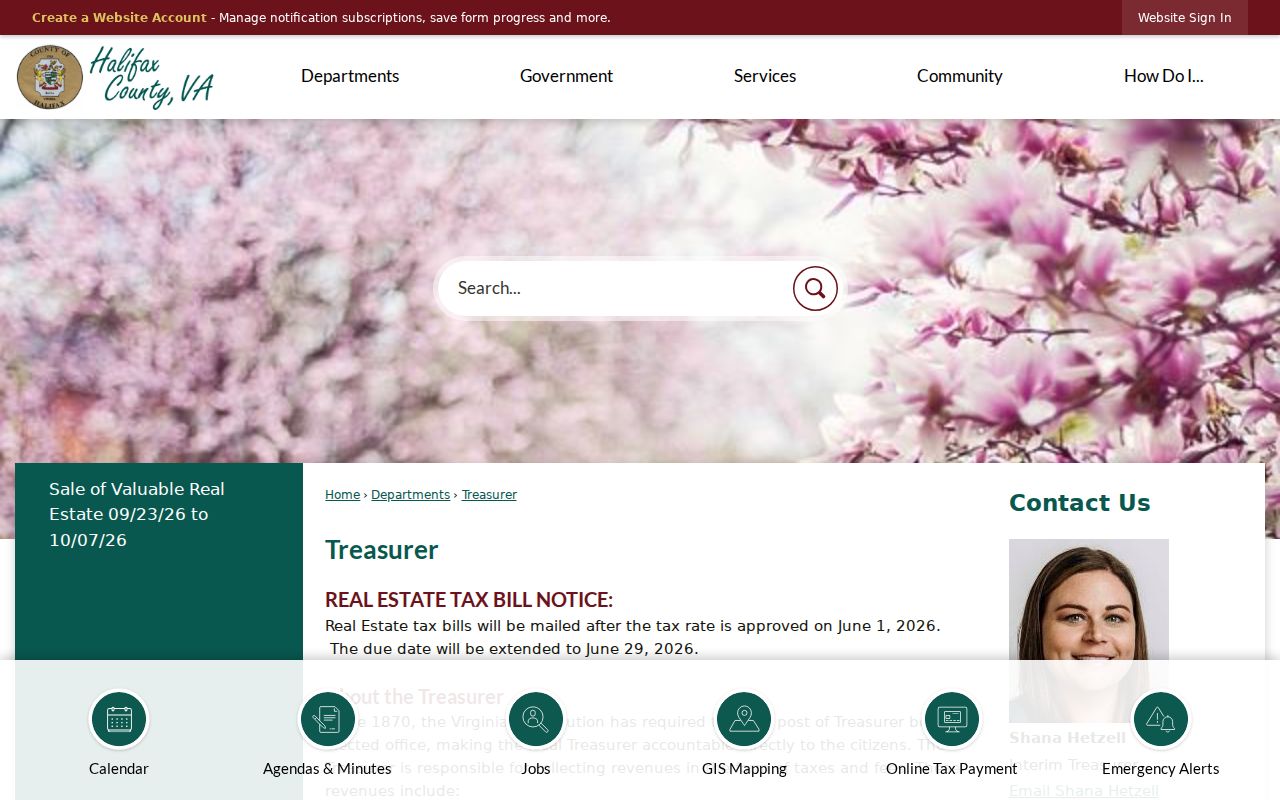
The image points to the Treasurer's official guidance. Confirm the live rate and any recent changes with Halifax County before computing a current bill.
Halifax County Property Value, Sale Price and Market Value
Three different numbers can attach to one parcel. A recorded transaction is a historical event. An assessment is a local tax value. A market-value opinion estimates a current exchange under stated assumptions. None of them is automatically wrong when they disagree. A deed's consideration reflects the date and terms of that transaction. A biennial assessment reflects Halifax County's model and cycle. A licensed appraisal rests on a defined purpose plus evidence from the property and market.
When someone asks what a property is worth, clarify the purpose first. Taxes, a prior sale, and an estimated current value each lead to a different record. Halifax's 100-percent assessment standard does not promise that every assessed amount equals a future sale price.
Halifax County Property Value Questions Start with the Record
A value that looks wrong deserves a slow first step. Confirm the parcel, the assessment year and the property description. The 2026 appeal form accepts overvaluation and undervaluation as grounds. It also accepts incorrect property-description data. Lack of uniformity with similar properties counts too. Listing those categories does not set a deadline or guarantee an outcome. Ask the assessment office about the current process, evidence and dates before filing.
A value dispute is not a deed dispute. The assessment office handles the land-book value. The Clerk holds recorded transfers. The Treasurer handles the bills. Keep those sources straight when requesting review.
What a Halifax County Property Value Does Not Tell You
A Halifax County property value has firm limits. It does not guarantee a sale price, reveal a building's condition, prove title clear or fix a surveyed boundary. The assessed amount exists for local taxation under the county's assessment program. A qualified appraiser serves sale, lending or specialized valuation needs. For ownership, inspect the latest recorded deed. For a tax bill, contact the Treasurer.
Assessment is not an appraisal. Halifax County standard helps set a tax baseline, but an assessed value is not a promise about what the parcel will sell for today.
Keep the amount, source and tax year together. That habit makes later comparisons meaningful and keeps a recorded sale figure from being passed off as a current Halifax County value.