
How a Halifax County Property Search Moves from Address to Record
Treat the address as the first clue, not the answer. It points you toward a parcel in WebGIS. The parcel record number then gets you to the right desk at the assessment office. The recorded deed settles what actually transferred. Halifax County offers no separate public assessor property-card interface online. WebGIS is the county's map route. For official ownership and land-book fields, the Commissioner of the Revenue remains one contact. The Real Estate Assessment Office handles the rest. That chain, address to parcel to deed, keeps a Halifax County property search honest. It holds true at each step.
| Starting clue | First useful stop | What to carry forward |
|---|---|---|
| Street address | Halifax County WebGIS | Parcel record number and map context |
| Owner name | Commissioner of the Revenue, then Circuit Court Clerk | Spelling variants and a likely deed date |
| Parcel number | WebGIS and the assessment office | Legal description, map image and book/page references |
| Old deed citation | Clerk's grantor-grantee index | Instrument type, parties and preceding deed |
Note which source supplied each item you write down. That small habit keeps a map label, an assessment entry, and a deed recital from blending into one conclusion no record actually supports.
Halifax County Property Search Starts with the Halifax County map
Halifax County WebGIS is the best public starting point for a parcel search. The county describes its GIS service as a mapping resource for citizens and departments. It covers parcels, zoning, and aerial views. A detailed aerial photo sits under the map as a base layer. Button labels, owner-search fields, and parcel tools inside the live viewer vary. So work with the interface as it appears. Whatever you find there, confirm it with the parcel number through a Halifax County office. Rely on it only after that check.
Halifax County's GIS and E-911 information explains the mapping service and what it offers.
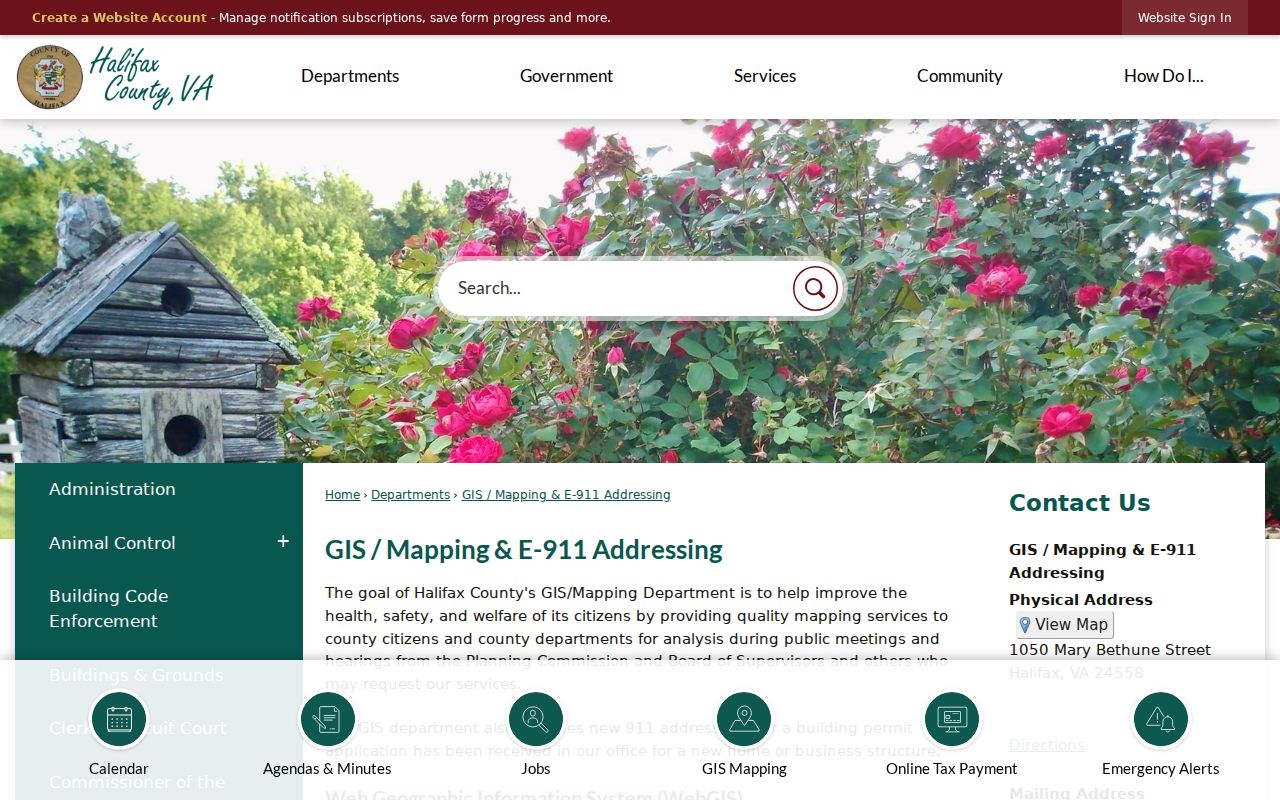
This Halifax County page supports a map-first route. A map image is still not a parcel result. If an address finds no match, try the road name alone. Try locating the road visually, and ask the mapping office how to resolve an older or rural address. Never invent an owner or a boundary from the aerial image. This approach earns its keep when a newer E-911 number differs from an older deed's road, community, or metes-and-bounds description. The parcel identifier gives follow-up offices a stable reference. It also helps while you compare the old description against the current map.
Halifax County Search Fields and the Clues They Connect
Halifax County publishes no full searchable property-card field list online. Its forms still reveal plenty. A building permit application asks for the project address, parcel record number, zoning, election district, and total acreage alongside jurisdiction and construction details. The assessment appeal form wants an owner, mailing address, parcel record number, property address, and land type. Those are form fields rather than an online assessor search inventory, but they show exactly which details staff use to identify a site and route the work.
| Verified form field | Why it helps a search | Where it appears |
|---|---|---|
| Parcel Record # | Bridges a permit or appeal to the parcel trail | Building permit and 2026 assessment appeal |
| Property address / project site | Identifies the situs or work location | Both Halifax County forms |
| Owner and mailing address | Separates owner contact from the site itself | Assessment appeal form |
| Zoning and election district | Adds a jurisdiction and planning context | Building permit form |
| Total acres and conditional use | Helps describe the site and proposed use | Building permit form |
The forms page carries a warning worth heeding. Some documents may contain protected personal information and should not travel by ordinary email unless the transmission is secured. Follow Halifax County's current form instructions instead of attaching sensitive material to a casual message.
What a Halifax County Property Search Result Can Show
Each record answers a different question. A map result ties a place to a parcel outline and a parcel record number. An assessment inquiry confirms the owner and value carried in the Halifax County land book. A deed result names the grantor, grantee, instrument date, recording reference, and legal description. A Treasurer account shows billing or payment history. Every result serves a different purpose and may be current on a different date.
Halifax County reassesses real estate every two years at 100 percent of fair market value. Current land-book information is published by September 1. A new deed, map edit, or mailing change may lag behind in other records. Names may disagree. Note the dates and ask the custodian whether a transfer is awaiting an update. No bill, deed, or aerial overlay alone settles present title.
The assessment page describes a uniform and equitable full-value standard. It publishes no separate field inventory for owner, situs, mailing address, last-sale date, or improvement value. Call the office when one of those exact fields matters to your search.
Halifax County Property Search Uses E-911 and Permit Clues
A new E-911 address usually follows a building-permit application. That explains why an address on a recent form can differ from an old deed description. The permit form itself carries useful clues. It lists the parcel record number and total acres. It flags any conditional use and names the election district. Jurisdiction choices are Halifax County, Town of Halifax, and Town of South Boston. The two town options add zoning permits. Utility fields cover public water, public sewer, private well, and septic, with named utility approvals. The Halifax County forms page advises allowing at least 10 business days for a building permit. It also posts a building-fee schedule, a zoning permit, an agriculture zoning permit, and a family-conveyance affidavit among other planning forms.
A permit file can be a good historical lead on a site. Treat it as an administrative record, though. It is not a deed. It is not proof a structure was ever finished. Pull current forms and routing from the official county forms page rather than older copies.
One caution ends the search cleanly. A town name or mailing city alone does not settle the matter. It does not confirm whether a lot sits inside incorporated limits.
Halifax County Owner Searches Need a Deed Check
The county publishes no online owner-name search through the assessor. The Commissioner of the Revenue maintains the real-estate ownership information. A caller can ask how to match a land-book entry to a parcel number or address. Once a likely owner surfaces, the Circuit Court Clerk's grantor-grantee index confirms the recorded conveyance. A land-book owner is an administrative reference. The Halifax County deed remains the recorded instrument that documents a transfer.
Names complicate things. Owner entries may show initials. They may also show middle names, suffixes, a trust, an estate, or a business entity. Search every spelling variant and keep the source date. For an LLC, the Virginia State Corporation Commission's business search can identify the entity filing. It never substitutes for a deed or a title examination. An owner's mailing address is not necessarily the property's street address or anyone's residence.
When you call, give the road or site address. Give the parcel record number if known. Ask which field is current. Ask whether a deed was recorded after the published land-book date.
Halifax County Deed Searches Have Separate Index and Image Access
The Halifax Circuit Court Clerk keeps the county's land records. Virginia's Secure Remote Access system covers participating circuit-court records, but access has layers. A local clerk must authorize registration. Viewing document images requires an authorized subscription agreement plus applicable fees. Some courts allow index-only access at no charge. Confirm Halifax's online start year and its free-index setting with the Halifax County Circuit Court Clerk. Do this before relying on remote coverage.
The Clerk's office sits at 8 S. Main Street, with mail to P.O. Box 729 in Halifax. Counter hours run 8:30 a.m. to 4:30 p.m. Ordinary mail should not go to the physical courthouse address. Include the parties and an approximate instrument date. Also add any book/page or parcel number in a request. Copy charges and payment instructions change. Confirm them directly. Statewide fee anchors never guarantee the local total.
For deed types and chain research, use the Halifax County deed records page. A deed image beats any third-party summary as evidence. A full title review may still need older instruments and professional examination.
Halifax County Property Search Across the South Boston Date Line
South Boston was an independent city from 1960 through 1995. Today it is a town inside Halifax County. That history is a real search clue. A deed from the city period may be indexed under South Boston. It may not carry the current county name. Keep both locality labels in your search record whenever a chain begins before the town rejoined Halifax County. The modern parcel and deed route points to Halifax County. But older property records can be organized differently.
ZIP codes mislead. A mailing community can reach past a legal town boundary. So never infer city limits from a ZIP. The parcel map and permit jurisdiction distinguish Town of South Boston, Town of Halifax, and the wider Halifax County. The Halifax County building permit form lists exactly those jurisdiction choices. South Boston planning materials cover zoning and land use.
Population figures carry their own dates. South Boston's 2020 Census count was 7,966. Its 2025 estimate was 7,795. Those numbers describe the place, not a parcel's jurisdiction or its assessed value.
Halifax County Search Results Need a Boundary Cross-Check
Halifax County WebGIS data is informational only. It changes constantly and never serves as a legal description. When a search result sits close to a line, pull the recorded deed. Its plat reference matters too. The written parcel description controls what the record means. Pixels on an aerial map hide fences, tree lines, roads and water. A real boundary question needs a licensed surveyor, never a measurement taken off a screen.
The county spans roughly 818 square miles. The Dan and Staunton rivers cross it. US 58 and US 360 run east to west. US 501 runs north to south. Rail lines pass through Halifax and South Boston. Those geography clues help orient a property search. They also explain why a rural deed cites a creek, road or community name. They still cannot replace the legal description. A neighbor living just across a river can fall under a different jurisdiction entirely.
To identify nearby parcels, copy the adjacent parcel numbers from the Halifax County map. Then verify each record on its own. A line touching the subject parcel is not a confirmed owner. It is not legal adjacency until the record description is checked.
When a Halifax County Online Search Stops
A Halifax County online search can stall. When the map returns no match, ask GIS or the assessment office for help. Ask how to search by road, parcel number or historic description. If the owner of record is unclear, ask the Commissioner about the Halifax County land book. Then check deed names in the Halifax County Circuit Court Clerk's index. When a deed image is not available remotely, ask about your options. A clerk-authorized subscription, a counter visit or a mailed request may work best. Older material lives in deed books or on microfilm, so ask which series to consult.
Virginia FOIA lets anyone request existing public records from a public body. A narrow ask, such as permit applications for one named parcel, fits the law well. The statute does not force an office to build a new title report. The general response period is five working days, excluding weekends and legal holidays. An office may claim seven more working days when a prompt reply is impracticable. Search, review, redaction, copying and delivery costs may apply. So request an estimate for anything broad.
Keep a request focused. Name the record type, the parcel number and the date range. That keeps a public-records request distinct from a professional title search.
Limits on a Halifax County Property Search
A Halifax County property search collects clues from official records. It certifies nothing on its own. It cannot settle who owns a deed. It cannot determine who occupies a home, guarantee map accuracy or forecast a sale price. Preserve the source and date of every result. Route questions to the right office. Transfers go to the Halifax County Circuit Court Clerk, land-book matters to the Commissioner, bills to the Treasurer, and physical boundaries to a surveyor. When a record mismatches, seek correction from the custodian rather than trusting the interface as definitive.
Use records responsibly. Public parcel and owner data is for lawful property research, due diligence and civic use. Do not use an address or owner lookup to follow, threaten or harass anyone.