
Halifax County Deed Records Document Different Transfers
Halifax County deed records live with the Circuit Court Clerk. The land books capture recorded instruments, not every private agreement about land. Before drawing any conclusion, read the instrument type and its complete text. A conveyance deed may name the grantor and grantee. It may also list the consideration, a parcel reference and the legal description. A deed of trust records a security interest. A later certificate of satisfaction may show that the obligation was released. Wills and probate filings can explain an estate transition. Still, the recorded deed or other legally effective instrument remains central. It anchors the land trail in Halifax County property records.
| Instrument | What it records | Follow-up |
|---|---|---|
| Deed of conveyance | Parties, date, consideration and property description | Read the description and cited prior deed |
| Deed of trust | A security instrument tied to property | Look for a later release or satisfaction |
| Certificate of satisfaction | Release entry associated with a prior lien | Match the reference and parties |
| Plat or map sheet | Recorded drawing or survey reference | Compare with deed calls and current parcel |
| Probate filing | Estate context and successor names | Confirm a later conveyance in land records |
The Halifax County Circuit Court Clerk's index is a finding aid. It is not the instrument itself, and it may not answer whether a lien was later released. A careful deed search keeps every citation paired with its document type.
Halifax County Deed Records Follow Grantor and Grantee Names
A grantor conveys an interest; a grantee receives it. Halifax deed research often moves from a known grantee to the Halifax County deed where that party acquired the parcel. Then it works backward to the earlier grantor. A forward check searches later grantor entries. It shows how the same party conveyed or encumbered the land. The deed chain is assembled from recorded documents and must be read in sequence. A matching surname alone does not prove two instruments concern the same tract.
Keep each party's full name, recording date, instrument type and book/page reference together. If an entry cites an earlier deed, retrieve it. Then compare the legal description, not just the names. The clerk publishes no statement of the earliest year in the online deed index. Ask the Halifax County Circuit Court Clerk where online coverage stops. Ask which physical books or microfilm continue the deed chain before assuming a search is complete.
The Halifax County Circuit Court Clerk and Halifax County Deed Records Access
The Halifax Circuit Court Clerk serves as custodian of Halifax County land records. The office sits at 8 S. Main Street in Halifax. Mail goes to P.O. Box 729, Halifax, VA 24558. The Clerk lists 434-476-6211 and counter hours of 8:30 a.m. to 4:30 p.m. Send ordinary mail to the post-office box rather than the courthouse street address. The Halifax Circuit Court page provides official clerk contact and counter details.
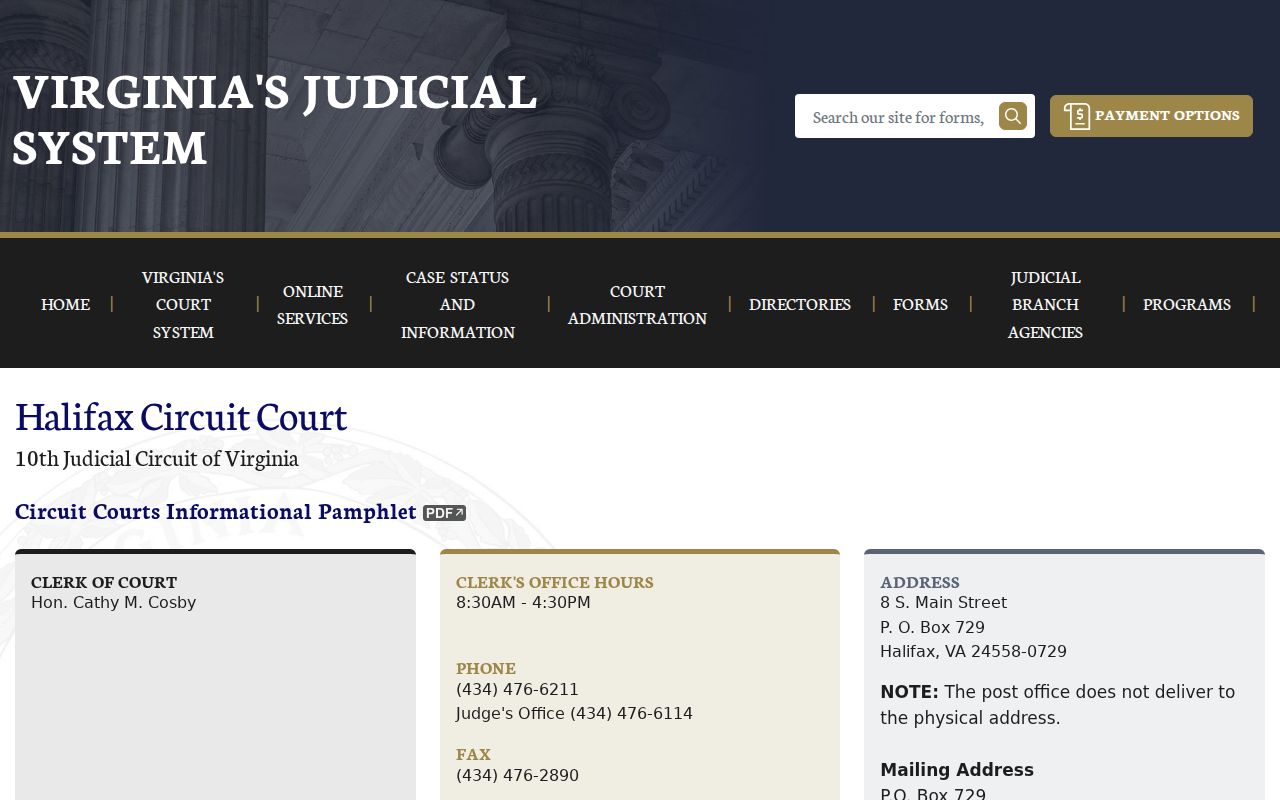
For mail requests to the Circuit Court Clerk, send them to P.O. Box 729. Always verify the current copy instructions before anything is mailed.
Deed records for Halifax County can also be reached online. Virginia Secure Remote Access serves participating circuit courts across the state. The local clerk must authorize any registration. Index-only access may be free where enabled. Document images require an authorized subscriber agreement plus applicable fees. A statewide portal does not mean every Halifax deed book or plat image is online. Coverage varies by locality.
The official Virginia SRA overview lays out the access model in detail.
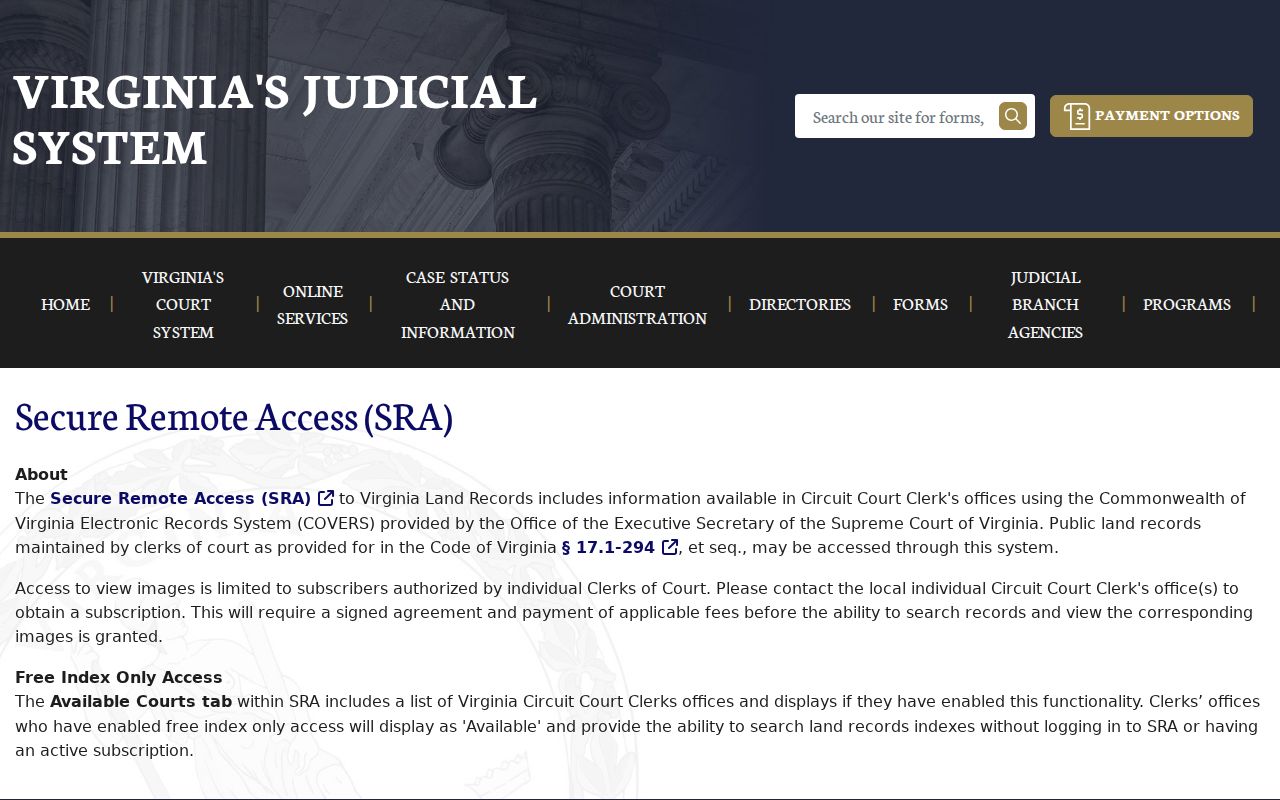
The access rules apply statewide. They do not guarantee that a specific Halifax record is available. Call the local clerk to confirm coverage, registration steps, and current cost before relying on the portal.
Requesting a Copy from Halifax County Deed Records
Have your details ready before you ask Halifax County for a copy. Bring the grantor and grantee names. Add a rough recording date. Include the property location and any book/page or parcel number on hand. Say whether you want a plain copy, a certified copy, or a map sheet. The Halifax County Circuit Court Clerk can explain how to submit the request. The clerk can also state the cost and how you will receive the record.
Virginia law sets fee anchors by instrument length. $18 covers 10 pages or fewer. $32 covers 11 through 30 pages. $52 covers 31 or more. Those figures come from the displayed version of §17.1-275. Plat or map sheets larger than 8.5 by 14 inches may add a $17-per-sheet charge. Taxes, technology charges, or other local totals can change the final amount. Confirm the current cost with Halifax before you send payment.
Halifax County also warns that some forms hold protected personal information. Those forms should not be emailed unless the transmission is secure.
Note: Use P.O. Box 729 for postal requests rather than the courthouse street address.
The 2025 Halifax County Deed Record Connects a Parcel to Book 701
A sample Halifax deed recorded in 2025 shows what one record can hold. It identifies parcel 30044, states $40,000 in consideration, lists an assessed value of $19,240, and cites a prior conveyance at Book 701, Page 849. The document describes a two-acre tract by metes and bounds and includes a title-insurance reference. Each figure answers a different question. Consideration is the amount stated for the transaction; the assessment is a tax-office value; and a title-insurance reference does not certify that every ownership question is resolved.
| Clue | How to use it |
|---|---|
| Parcel 30044 | Locate a map or assessment record, then confirm parcel continuity. |
| $40,000 consideration | Record as the amount stated, not today's market value. |
| $19,240 assessed value | Compare with the Halifax County land book and relevant year. |
| Book 701, Page 849 | Retrieve the prior instrument to continue the Halifax County deed chain. |
| Two-acre metes-and-bounds tract | Compare written calls with a plat or survey. |
Work backward from the cited conveyance in Book 701. Compare the parties and the legal description line by line. A parcel number is useful for matching the deed against the WebGIS parcel layer, but the legal description and the recorded chain of title form the stronger link between documents. If that book and page is not open to view online, the Halifax County Circuit Court Clerk can explain how to inspect the physical volume in person.
Older Halifax County Deed Records Need a Coverage Check
The online cutoff year for Halifax deed records is not published. Ask the Halifax County Circuit Court Clerk which years and document classes SRA covers. Ask where earlier volumes sit. Halifax formed from Lunenburg in 1752. But that date alone does not mean a current online index reaches back that far. Older deeds may still live in bound volumes at the courthouse.
The Library of Virginia catalog lists Halifax County microfilm and original-record holdings. The county also has a digitized 1924 history by Wirt Johnson Turner Carrington. The Halifax Public Library holds WPA Virginia Historical Inventory material. Chaffin House and the South Boston-Halifax County Museum keep local research collections. These can tie old names, roads, churches, and mills to a book citation. These sources aid the hunt. They never replace a recorded conveyance.
See the Library of Virginia Halifax catalog for holdings.
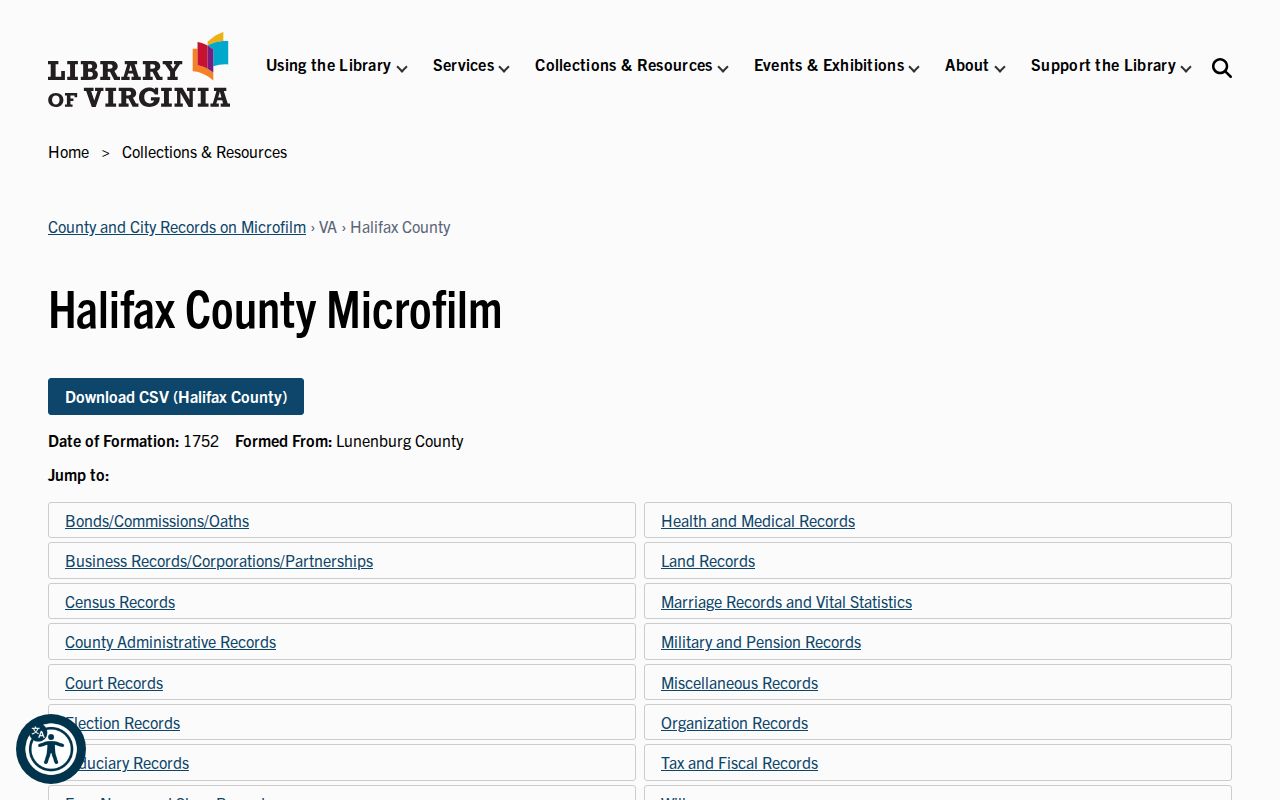
That catalog image points to archival material rather than a searchable deed index. Confirm where a needed volume is held before you plan a visit.
Microfilm for Older Halifax County Deed Records
Older research starts with the Library of Virginia Halifax County catalog, which lists microfilm holdings. Vital records add historical color. Surviving Virginia births and deaths run from 1853 through 1896. Marriages run from 1853 onward. But none of these replaces a land instrument. The Library holds microfilm copies of surviving early vital records, including pre-1936 marriages. Viewing microfilm is free. Interlibrary loan may reach your local branch. The Virginia Department of Health issues certified copies. It states plainly that it cannot perform genealogical research for you.
Two local centers deepen the work. Chaffin House is the Halifax County Historical Society research center. It keeps documents, maps and books on civic, religious and historic events. The South Boston-Halifax County Museum Genealogy and Research Center reports more than 1,500 books. It also holds 2,000 archival items, manuscripts and files. The museum also reports a batch of historic papers went to the state library for preservation and digitization. So confirm access before counting on that project's status.
The Virginia Department of Health genealogy page explains archival microfilm and public vital-record periods.
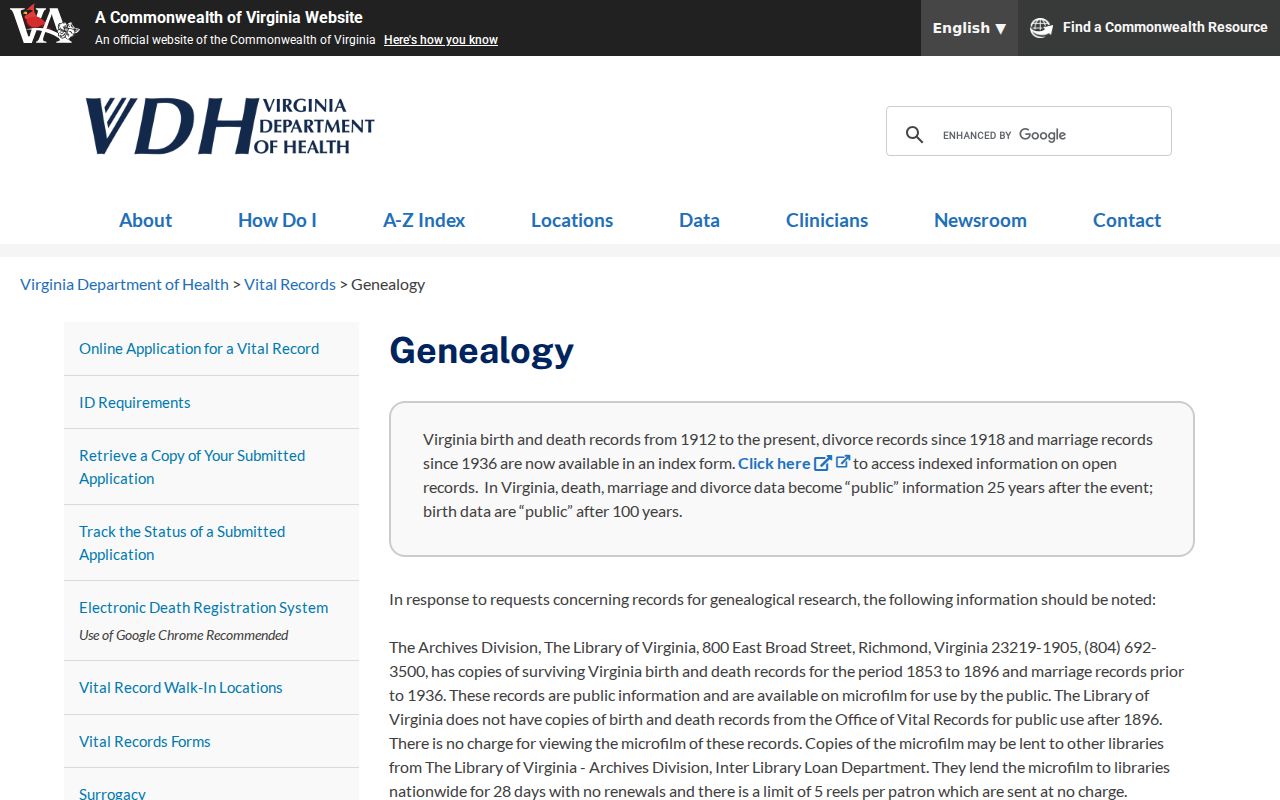
That image traces the archival route for historical research. Certified records and title evidence follow their own custodian paths.
South Boston Locality Labels in Halifax County Deed Records
South Boston complicates locality labels. The town was an independent city from 1960 through 1995 before rejoining Halifax County. A deed recorded in those years may sit under the city's own indexing. When a chain of title crosses that span, search the old South Boston label. Pair it with the current Halifax County route. Never assume a modern locality filter catches every instrument filed during the independent-city period.
Record-keeping discipline matters here. Keep the date and locality with each index citation. If the Halifax County Circuit Court Clerk points to a historical volume or separate index, write down the source exactly. Then ask how it connects to Halifax County books. A continuous property history may need both jurisdiction names. For wider house-history clues, the museum and historical society can identify a street, industry or community reference. Some of these no longer match today's mailing label.
VA Deed Alert and Halifax County Deed Records
Halifax posted Virginia's VA Deed Alert service in March 2026. The service sends notices when specified names appear in recorded land documents. It can help monitor a name after a transfer or flag a later filing. A notice is not an ownership certificate, though. It does not build a complete chain. It also may not explain an instrument's legal effect. Read the recorded document itself. Ask the Halifax County Circuit Court Clerk whenever a result needs clarification.
Stick with the official judicial-system service and follow its current instructions. Names vary across initials, trusts, estates and business entities, so match carefully. Treat the alert as a monitoring layer once you have identified the party or parcel. It cannot replace reviewing earlier deeds.
The statewide VA Deed Alert service appears among Virginia's online court services. It sits alongside SRA and case-information tools.
Descriptions in Halifax County Deed Records
Legal descriptions in Halifax County deed records take a few common forms. Some use lot and block. Others cite a recorded plat. Many older parcels rely on metes and bounds. That method traces courses and distances from a fixed point of beginning. In the sample two-acre tract, read each call exactly as written, then pull any deed or plat the description references. Compare them side by side.
Boundaries can mention neighboring owners, a road, a stream, or a set monument. A sketch drawn over aerial imagery is only a representation. It cannot settle which legal call controls or whether a marker still stands. For the record copy, ask the Halifax County Circuit Court Clerk. If a physical boundary matters, hire a licensed surveyor.
A few terms recur throughout deed records. The grantor conveys the land. The grantee receives it. Consideration is the amount stated in the deed. Book and page pinpoint the recorded instrument in the clerk's deed books. These labels organize a property search, though they promise neither market value nor insurable title.
Limits of Halifax County Deed Records
A recorded deed proves an instrument entered the public land-record system, nothing more. It does not promise a full online index. It does not promise that an old description surfaces easily, or that every later lien was released.
A deed records search is not a title examination. Treat it as one layer. Confirm coverage and fees with the Halifax County Circuit Court Clerk, keep your book and page citations, and weigh each instrument against the Halifax County land book as a separate source.
The former-owner guide explains how to follow prior transfers.
Verify before relying. Do not use a deed summary, parcel image or alert alone when a title or boundary question has legal or financial consequences. Ask the custodian for the record and a qualified professional for title advice.